The right air rifle depends on the job: a young shooter’s first rifle, backyard plinking, garden pests, small game or target shooting. Power level, caliber and powerplant all follow from that choice, and a rifle that is right for one job is often wrong for another. Any young shooter needs an adult supervising, everyone in range needs eye protection, and airgun laws vary by state and city, so check local rules before you buy.
This guide starts with how to read the numbers on a box, then walks through each job with listed specifications and what each pick gives up. Velocities are manufacturer claims, and prices are the listed figures from October 2026.
- Pick the job first: first rifle, plinking, pests and small game, or target shooting.
- Treat box velocity as a manufacturer claim, and compare energy and pellet weight.
- State rules on caliber differ, so check your state wildlife agency before choosing for pests or game.
- Every pick gives something up: speed, repeat shots, noise, cost or technique.
Read the numbers before you shop
Box velocity is the first number everyone sees and the least reliable. Crosman’s ballistics page says the advertised velocity for any air rifle is usually based on a very light pellet and may be a generous estimate, and it gives the example of a break-action rifle advertised at 1000 ft/sec that might deliver only 875-900 ft/sec with pellets of normal weight [1].
It also notes that in .177 caliber a very light pellet might weigh 6.7 grains, a normal one 7.9 grains and a heavy one as much as 10 grains, and that heavier pellets can be 100-150 ft/sec slower [1].
Energy tells you more than speed. Muzzle energy in foot-pounds is weight in grains times velocity squared divided by 450,240, so a heavier pellet at a lower speed can carry more energy. For example, an 8-grain pellet at 800 fps makes 11.37 foot-pounds [2]. When a listing states muzzle energy, treat it as the maker’s maximum under its own test conditions.
Powerplant in one paragraph each
Spring-piston rifles compress air with a coil spring released by the trigger, and break-barrel is a cocking method used with spring and gas piston guns rather than a separate powerplant [3]. Crosman describes its gas piston guns as offering quieter shots, reduced vibration and no spring wear when left cocked [3].
Pump pneumatics store air you add by hand. Crosman says single-pump guns always fire at the same speed, while variable-pump guns need a minimum of three pumps and up to 12 for a full-power shot [3]. CO2 guns run on small cartridges, with a pressure of about 900 PSI when used optimally [4]. Pre-charged pneumatic rifles are filled from an external source, and most reservoirs need to be filled to between 2000 and 4500 PSI [3].
Job one: a first rifle or backyard plinking
For a new shooter the priorities are low power, easy operation and adjustable fit. An adult has to supervise, and the maker’s age guidance matters: Daisy recommends its Red Ryder for ages ten and up under adult supervision [5], and Crosman marks its 1377 and 1322 pump pistols for users 16 and older [6]. Always follow the manual for the exact model.
Crosman 760 Pumpmaster
Crosman lists the 760 Pumpmaster as a variable pump rifle with adjustable power from 350 to 700 feet per second depending on pumps, shooting both 4.5mm steel BBs and .177 pellets, at $60.90 in October 2026. The tradeoff is a smooth bore barrel, which Crosman’s listing notes, and steel BBs that can ricochet off hard surfaces, so use a proper backstop and never shoot at a flat hard surface or water [7]. The listing does not state an age recommendation, so check the manual and local age rules.
Crosman Tyro
The Tyro is a .177 youth break-barrel spring rifle with a grow-with-me stock and a listed cocking effort of 22 pounds, priced at $84.90 in October 2026. It gives up quick follow-up shots: a break-barrel springer like this is cocked by hand before each shot.
Job two: garden pests and small game
Pest and small game work calls for energy at the target and a rifle you can shoot accurately from a rest. Your state wildlife agency sets the rules for what you may shoot and with what, so read them before you choose a caliber. Pennsylvania, for example, lists air rifles between .177 and .22 caliber for small game other than woodchucks [8], while West Virginia says no one may hunt small game with an air rifle of less than .22 caliber [9].
One retailer’s mailbag comparison on a single rifle showed 986.6 fps and 15.13 foot-pounds in .177 with 7.0-grain RWS hobby pellets, against 780.8 fps and 16.37 foot-pounds in .22 with 11.9-grain RWS hobby pellets [10]. Neither number is a promise for your rifle, but on that rifle the heavier .22 pellet carried slightly more energy at a lower speed.
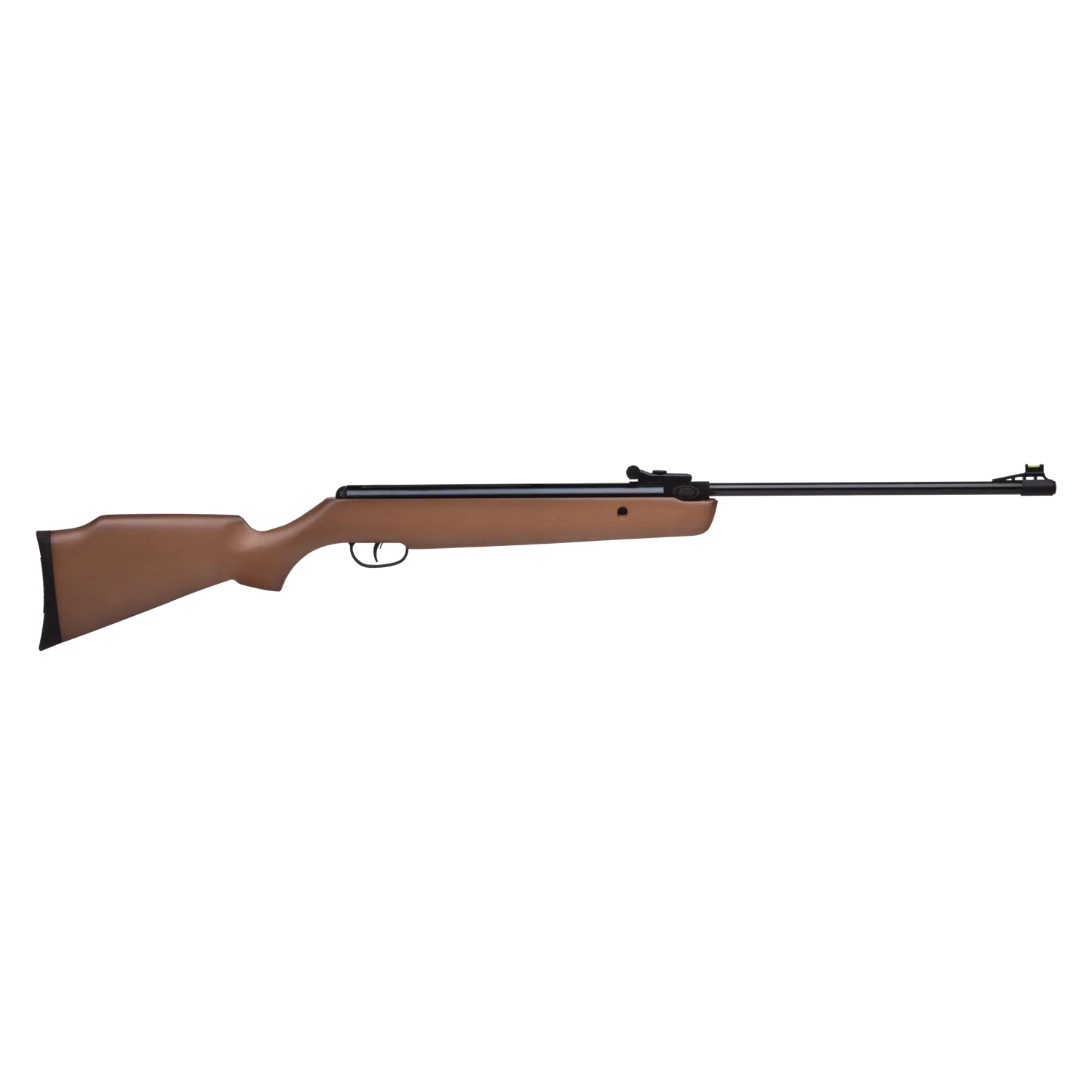
Crosman Vantage NP (.22)
Crosman lists the .22 Vantage NP as a Nitro Piston break-barrel rifle with up to 950 fps, and describes its energy as suited to small game and pest control, at $106.90 in October 2026. It gives up repeat shots: it is a single shot.
Hatsan Model 135 Vortex
Hatsan lists its .22 Model 135 Vortex gas piston rifle with a maximum muzzle energy of 33 FPE and up to 1000 fps with lead pellets; an Amazon listing showed $294.99 in October 2026. The price is nearly three times the Vantage, and the maker cautions that results vary with pellet weight, shape and temperature.
Job three: target shooting and accuracy
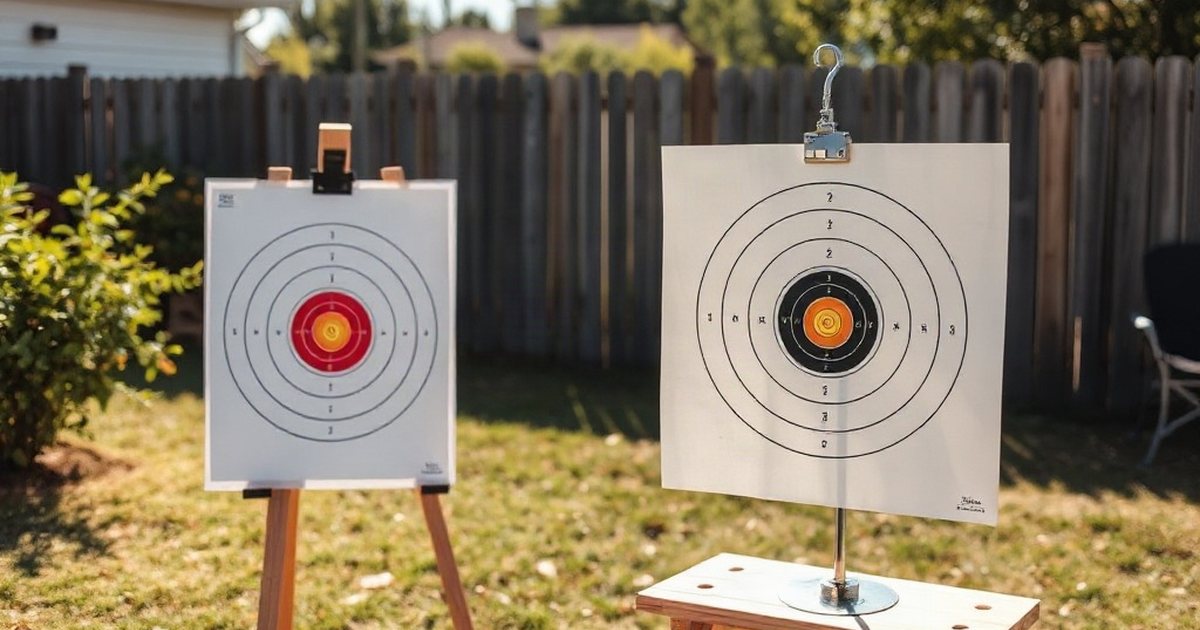
Accuracy comes from consistency [11] [12] [13].
Springers need a loose hold, since one retailer guide says a spring gun is not to be shouldered tightly or accuracy will suffer [11], and spring recoil is known to damage scopes not rated for spring guns [12]. For paper targets, wadcutter pellets are designed to cut round holes and suit competition and target shooting [13].
A regulated pre-charged rifle is aimed at repeatable shots, at a higher cost and with fill equipment to buy. Crosman lists the Benjamin Marauder Gen3 with a 500cc reservoir filled to 3625 PSI, an adjustable regulator and a price of $829.90 in October 2026. Follow the maker’s fill pressure and cylinder inspection rules, since high-pressure air is dangerous. The Marauder manual, for one, says not to use a standard air compressor or bicycle pump [14].
Budget for more than the rifle
Plan for eye protection, a pellet trap or backstop, ammunition and, for spring and gas piston rifles, a scope that is rated for their recoil. Crosman lists its Shooting Safety Glasses at $6.90 in October 2026. A tin of pellets is a small cost next to the rifle, and pellet choice changes accuracy, so try a few shapes and weights before settling.
Whatever you buy, read the manual before the first shot. The basics repeat across makers: Daisy says to treat every gun as if it were loaded [7], and Crosman’s manual says not to shoot at hard surfaces or water because the pellet may bounce off or ricochet [6].
A cheaper step up
If you want more power than a pump gun without PCP costs, a spring rifle is one common route. Diana lists the Two-Sixty in .22 at up to 755 feet per second and a maximum of 17.7 FPE; an Amazon listing showed $99.99 in October 2026. Hatsan lists the 1000X in .177 with a maximum muzzle energy of 20 FPE; an Amazon listing showed $160.99 in October 2026. The tradeoff with springers is the cocking effort, the recoil and the technique they demand.
FAQ
What is the best air rifle for a beginner?
For an adult-supervised first rifle, look for low power and simple operation. Crosman lists the 760 Pumpmaster with adjustable 350 to 700 feet per second power, and the maker’s manual and local age rules apply.
Is a higher fps always better?
No. Box velocity is usually measured with a very light pellet and may be generous, according to Crosman [1]. Energy and accuracy with the pellet you will actually use matter more.
Which caliber is better, .177 or .22?
It depends on the job and state rules. One retailer comparison found .22 gave more energy at a lower speed on the same rifle [10], and West Virginia bars small game hunting with less than .22 [9].
Spring, gas piston or PCP?
Spring and gas piston rifles are self-contained and need technique. PCP rifles need a fill source and a pressure range such as the 2000 to 4500 PSI that Crosman describes for most reservoirs [3].
Match the rifle to the job and follow its manual. Airgun laws vary by state and city, and some places treat airguns as firearms, so check local rules. Use a safe backstop, wear eye protection, treat every airgun as loaded, and keep young shooters under adult supervision.
Sources
- Air Gun Ballistics. Crosman (airgun manufacturer), accessed 2026-10-13
- Muzzle Energy Explanation & Definition. Pyramyd AIR (airgun retailer), accessed 2026-10-13
- How Does an Air Gun Work? Air Gunning 101. Crosman (airgun manufacturer), accessed 2026-10-13
- Mechanics of a Multi-Pump Airgun. Airgun Depot (airgun retailer), accessed 2026-10-13
- Daisy Operation Manual: 105 Buck, 95 Timberwolf, 1938 Red Ryder Spring-Air BB Rifles. Daisy Outdoor Products (operation manual PDF hosted by Pyramyd Air), accessed 2026-10-13
- Crosman 1377 / 1322 Single Shot Pellet Pump Air Pistol Owner's Manual (P/N 1377F515). Crosman Corporation (owner’s manual PDF hosted by Pyramyd Air), accessed 2026-10-13
- Safety Procedures (Airgun Shooting Safety Rules). Daisy Outdoor Products (manufacturer), accessed 2026-10-13
- 58 Pa. Code 141.22 – Small game seasons (permitted devices). Pennsylvania Code (Pennsylvania Game Commission regulation), accessed 2026-10-13
- W. Va. Code 20-2-5k – Use of air rifles to hunt. West Virginia Legislature, accessed 2026-10-13
- From the Mailbag: .177 vs .22 for hunting. Airgun Depot (airgun retailer), accessed 2026-10-13
- How to Get a Springer to Shoot Straight. Airgun Depot (airgun retailer), accessed 2026-10-13
- Air gun. Wikipedia, accessed 2026-10-13
- Airgun Ammunition. Crosman (airgun manufacturer), accessed 2026-10-13
- Benjamin Marauder pre-charged pneumatic airgun owner's manual (BP1764/BP2264/BP2564). Crosman Corporation (Benjamin; manufacturer manual, hosted by Pyramyd AIR), accessed 2026-10-13
Velocity, energy and shot-count figures are quoted as the manufacturer states them unless a test source is named. Airgun laws vary by state, county and city, and some places treat airguns as firearms; check your local law before buying or shooting. Adults should supervise young shooters, and everyone in range should wear eye protection. Hunting and pest control are governed by state wildlife rules. We do not sell or link to firearms or firearm ammunition. This is general information, not legal advice. As an Amazon Associate we earn from qualifying purchases.