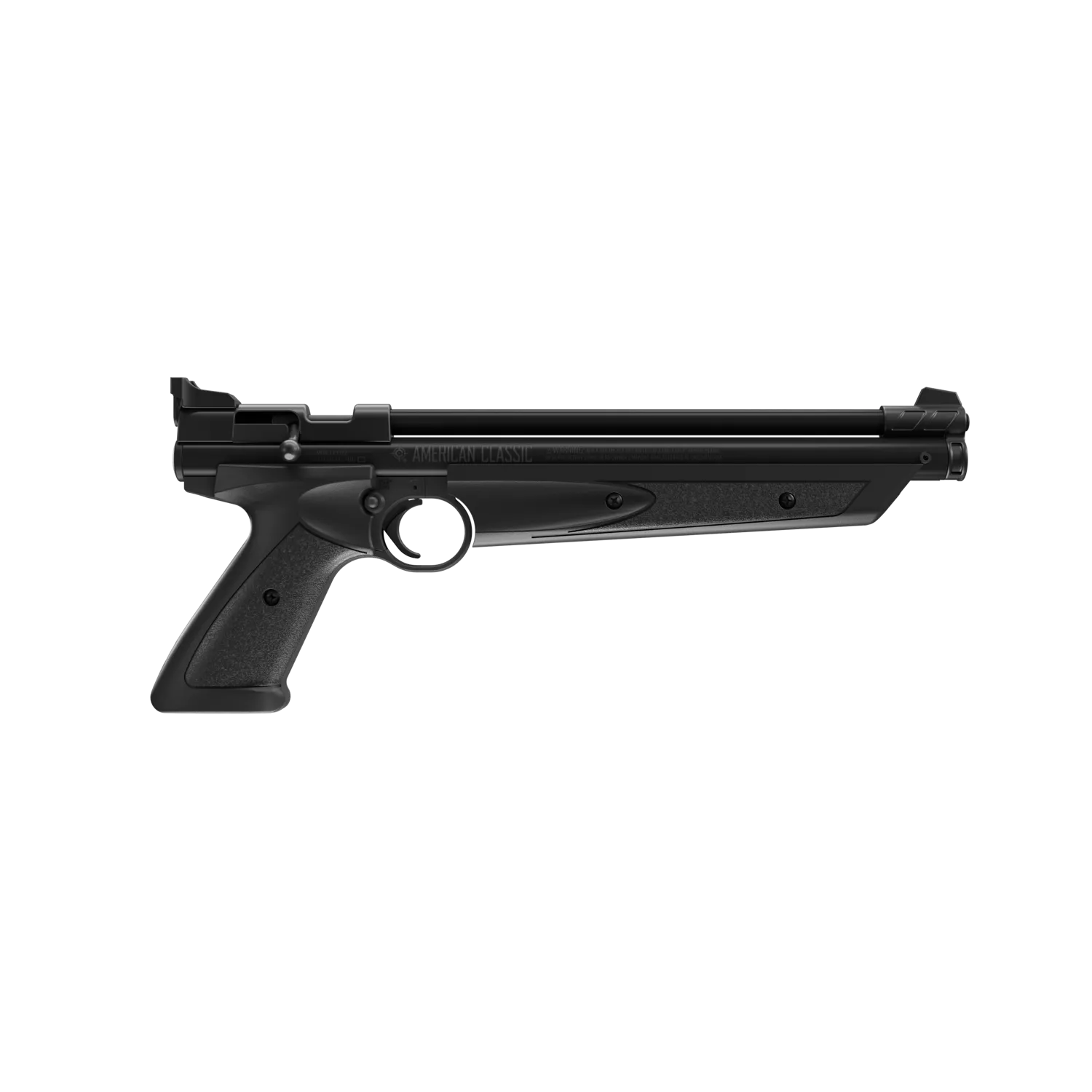
Choose a pellet pistol by the job it has to do. A pistol for paper targets in a garage, a pistol for a quick session on tin cans and a pistol for competition are three different purchases, and the power source follows from the job, not the other way round. This guide covers the three main choices, CO2, pump and PCP, plus a gas-piston option, and says what each gives up.
Airgun laws vary by state and city, and some places treat airguns as firearms, so check your local rules before you buy. Everyone in range should wear eye protection, and a younger shooter needs direct adult supervision; Crosman rates its 1377 and 1322 pump pistols and its 2240 CO2 pistol for ages 16 and older [1] [2].
- Decide the job first; the power source follows from it.
- Pump pistols need no fuel; CO2 needs cartridges and loses velocity in the cold; PCP needs fill gear [3] [4].
- A PCP target pistol such as the Crosman 1701P was listed at $509.90 in October 2026.
- Check your state and local laws, and your state wildlife agency before any pest control.
Start with the job
Write down what you want the pistol to do and where you will shoot. Paper targets at close range call for accuracy and a trigger you can feel. Casual plinking calls for something cheap that you can leave in a drawer. Pest control and small game call for energy and for knowing your state wildlife agency’s rules before any shot is taken. Competition calls for repeatable shots and the right rule-book fit.
Power is the trap. A box velocity is the maker’s claim, usually set with a very light pellet, and can be generous [5]. A pistol is a short-range tool, and a little more fps does not change that.
Pump pistols: simple and fuel-free
A pump pistol stores air that you pump in by hand. Crosman describes variable pump guns as needing a minimum of three pumps to shoot, with the number of pumps controlling the power [3]. The Crosman 1377 manual limits it to 3 to 10 pumps per charge and warns that over-pumping can cause major damage [1].
The Crosman 1377 Classic is a .177 variable pump pistol listed at up to 695 fps and $84.90 in October 2026. Its .22 sibling, the Crosman 1322 Classic, lists up to 460 fps and $97.90 in October 2026. Pump pistols give up speed and consistency, because the shot depends on your pumping, and they hold a single pellet at a time. They gain a lot too: no cartridges and no fill gear.
CO2 pistols: quick and easy, but weather matters
A CO2 pistol uses a 12-gram cartridge. The Crosman 2240 is a .22 bolt-action CO2 pistol listed at up to 460 fps and $85.90 in October 2026. CO2 pressure is set by temperature and holds steady while liquid remains in the cartridge, so the push stays steady while the cartridge is warm and you are not firing rapidly [6].
The cost is weather and consumables [4] [7] [2].
A retailer reports velocity drops of 10 to 20 percent as temperatures approach freezing [4], and cartridges must stay below the maker’s heat limit, with Umarex and Crosman giving 120 F [7] [2]. Crosman also wants the cartridge removed for long storage [2]. A 15-count pack of 12-gram cartridges was listed at $9.46 in October 2026 [6].
PCP pistols: refined, but they need fill gear
A PCP (pre-charged pneumatic) pistol is filled with high-pressure air from a hand pump, compressor or tank and then shoots many shots from one fill. PCP guns have low recoil because no heavy mechanical parts move during the shot [8]. The Crosman 1701P is a .177 PCP target pistol listed at up to 550 fps and about 50 shots per fill, at $509.90 in October 2026.
The Benjamin Marauder pistol lists up to 800 fps and 15.54 ft-lbs in .22, but catalog data marks it unavailable. The listing says up to 800 fps, but the owner’s manual says the pistol is factory set to approximately 700 fps, so treat 800 as a best case [9] [10].
Its manual allows fills of 2500 psi up to 3000 psi, never above 3000 psi, and says not to use a bicycle pump or standard air compressor [9]; the Marauder rifle manual specifies a pump made for pre-charged airguns with a Foster fitting [10]. A Benjamin hand pump was listed at $209.90 in October 2026.
A PCP pistol gives up simplicity and money. Pump or compressor, filling rules and tank inspection all come with it, and high-pressure air is dangerous; follow the maker’s pressure rules to the letter.
Gas-piston break barrels: the self-contained option
A Nitro Piston pistol compresses nitrogen, not a spring, and Crosman lists quieter shots, less vibration and no spring wear when left cocked [3]. The Benjamin Trail Mark II lists up to 525 fps with a lead pellet, 625 fps with an alloy pellet and a cocking effort of 20 lbs, at $116.90 in October 2026.
It needs no cartridges, pump or fill gear, and it gives up an easy cocking stroke, with a 20 lb effort listed. One maker says spring-piston airguns typically need 500 to 1,000 shots to break in [11]; that source is about spring guns, so check what the maker of a gas-piston pistol says.
What to read in a listing before you buy
Listings carry more useful detail than the headline velocity. Look for the caliber, the action, whether the barrel is rifled, the sights, the trigger type and whether a magazine is included. The Crosman 1377 listing, for example, gives a rifled steel barrel, an adjustable rear sight, a single-stage trigger and no magazine. The 1701P gives a two-stage adjustable trigger and a reversible bolt.
Also look at availability.
Catalog data marks some pistols as discontinued or unavailable, such as the Benjamin Marauder pistol, and it is better to know before you plan around one. And check what is not in the box: the CO2 cartridge is not included with the Crosman 2240, and you need your own fill gear for a PCP pistol.
Running costs over time
Think of three buckets. The pistol is the first. The second is the fuel: nothing for a pump or gas-piston pistol, cartridges for CO2, and a pump, compressor or tank for PCP. The third is ammunition, plus a trap or backstop and targets.
A beginner who shoots a few times a month will spend least on a pump pistol and most on a PCP setup. A frequent shooter may find that cartridge costs add up on CO2, while a PCP shooter pays up front for fill gear. Take care of the seals either way: Crosman’s CO2 pistol manual wants a drop of oil where it directs when you install a cartridge, and oil on the bolt o-ring every 250 shots [12], and its pump pistol manual wants the pump cup oiled every 250 shots [1].
A quick matching guide
- First pistol, paper targets, small budget: a pump pistol such as the Crosman 1377.
- Easy, repeatable shots without pumping: a CO2 pistol such as the Crosman 2240, with the weather caveat.
- Competition or a lot of shooting: a PCP target pistol such as the Crosman 1701P.
- No accessories at all: a gas-piston break barrel such as the Trail Mark II.
- Small pests: check state wildlife rules first; for scale, the Crosman 1377 is listed at 6 ft-lbs. Wild birds are protected under the federal Migratory Bird Treaty Act. [13]
Pellets, targets and safe handling
Pellet shape follows the job. Crosman describes wadcutters as the choice for competition, target shooting and plinking, and domed pellets as the shape that keeps energy longest [14]. Use the caliber your pistol is made for; the Crosman 1377 takes only .177 and the 1322 only .22 [1].
Every shot needs a safe backstop. Treat every airgun as loaded, check behind and beyond the target and never shoot at hard surfaces or water [15]. Wash your hands after handling lead pellets and keep food off the range [16]. Store the pistol unloaded and keep ammunition apart, out of reach of children [17].
FAQ
Which is better for a pellet pistol, CO2 or pump?
It depends on the job. CO2 gives a steady, easy shot but needs cartridges and loses velocity in the cold [4]. A pump pistol needs no cartridges but asks 3 to 10 pumps per shot [1].
Do I need a PCP pistol?
Not for most casual shooting. A PCP pistol such as the Crosman 1701P lists about 50 shots per fill but needs fill gear.
What age should a shooter be for a pellet pistol?
Crosman’s manuals state that its 1377, 1322 and 2240 pistols are intended for users 16 and older [1] [2]. Younger shooters need direct adult supervision.
Is a pellet pistol good for pest control?
Pistol energy is limited; for example the Crosman 1377 lists 6 ft-lbs. Rules for pests and hunting differ by state, so check your state wildlife agency first, and wild birds are protected under the federal Migratory Bird Treaty Act. [13]
Airgun laws differ by state and city. Pellets can injure eyes and skin, and high-pressure air and CO2 are hazards in their own right. Wear eye protection, use a safe backstop and store the pistol unloaded, away from children.
Sources
- Crosman 1377 / 1322 Single Shot Pellet Pump Air Pistol Owner's Manual (P/N 1377F515). Crosman Corporation (owner’s manual PDF hosted by Pyramyd Air), accessed 2026-10-13
- Crosman Model 2240 .22 Caliber Single Shot Pellet CO2 Airgun Owner's Manual (2240A515). Crosman Corporation (owner’s manual PDF, copy hosted by arprotech.com), accessed 2026-10-13
- How Does an Air Gun Work? Air Gunning 101. Crosman (airgun manufacturer), accessed 2026-10-13
- How Weather Affects Your CO2 Air Rifle's Performance. Airgun Source Canada (airgun retailer blog; its own testing, not a standards body), accessed 2026-10-13
- Air Gun Ballistics. Crosman (airgun manufacturer), accessed 2026-10-13
- What About CO2? (B.B. Pelletier / Tom Gaylord). Pyramyd AIR (airgun retailer), accessed 2026-10-13
- Use and Handling of CO2 Capsules (88g). Umarex USA / Walther (airgun manufacturer), accessed 2026-10-13
- Air gun. Wikipedia, accessed 2026-10-13
- Benjamin Marauder PCP Air Pistol Owner's Manual (BP2220-515). Crosman Corporation / Benjamin (owner’s manual PDF hosted by Pyramyd Air), accessed 2026-10-13
- Benjamin Marauder PCP Air Rifle Owner's Manual (BP1764 / BP2264 / BP2564). Crosman Corporation / Benjamin (owner’s manual PDF hosted by Pyramyd Air), accessed 2026-10-13
- How Spring Guns Work & How to Maximize Their Effectiveness. Umarex USA (airgun manufacturer), accessed 2026-10-13
- Crosman Model 2300S .177 Single Shot Pellet CO2 Air Pistol Owner's Manual (2300SB515). Crosman Corporation (owner’s manual PDF, copy hosted by MidwayUSA), accessed 2026-10-13
- 16 U.S.C. 703 – Taking, killing, or possessing migratory birds unlawful. Cornell Legal Information Institute (U.S. Code text), accessed 2026-10-13
- Airgun Ammunition. Crosman (airgun manufacturer), accessed 2026-10-13
- Safety Procedures (Airgun Shooting Safety Rules). Daisy Outdoor Products (manufacturer), accessed 2026-10-13
- Guide to Lead Management for Air Gun Shooting. USA Shooting and the Civilian Marksmanship Program (shooting-sports bodies, an interested party), accessed 2026-10-13
- Gun Safety Tips. Safe Kids Worldwide, accessed 2026-10-13
Velocity, energy and shot-count figures are quoted as the manufacturer states them unless a test source is named. Airgun laws vary by state, county and city, and some places treat airguns as firearms; check your local law before buying or shooting. Adults should supervise young shooters, and everyone in range should wear eye protection. Hunting and pest control are governed by state wildlife rules. We do not sell or link to firearms or firearm ammunition. This is general information, not legal advice. As an Amazon Associate we earn from qualifying purchases.