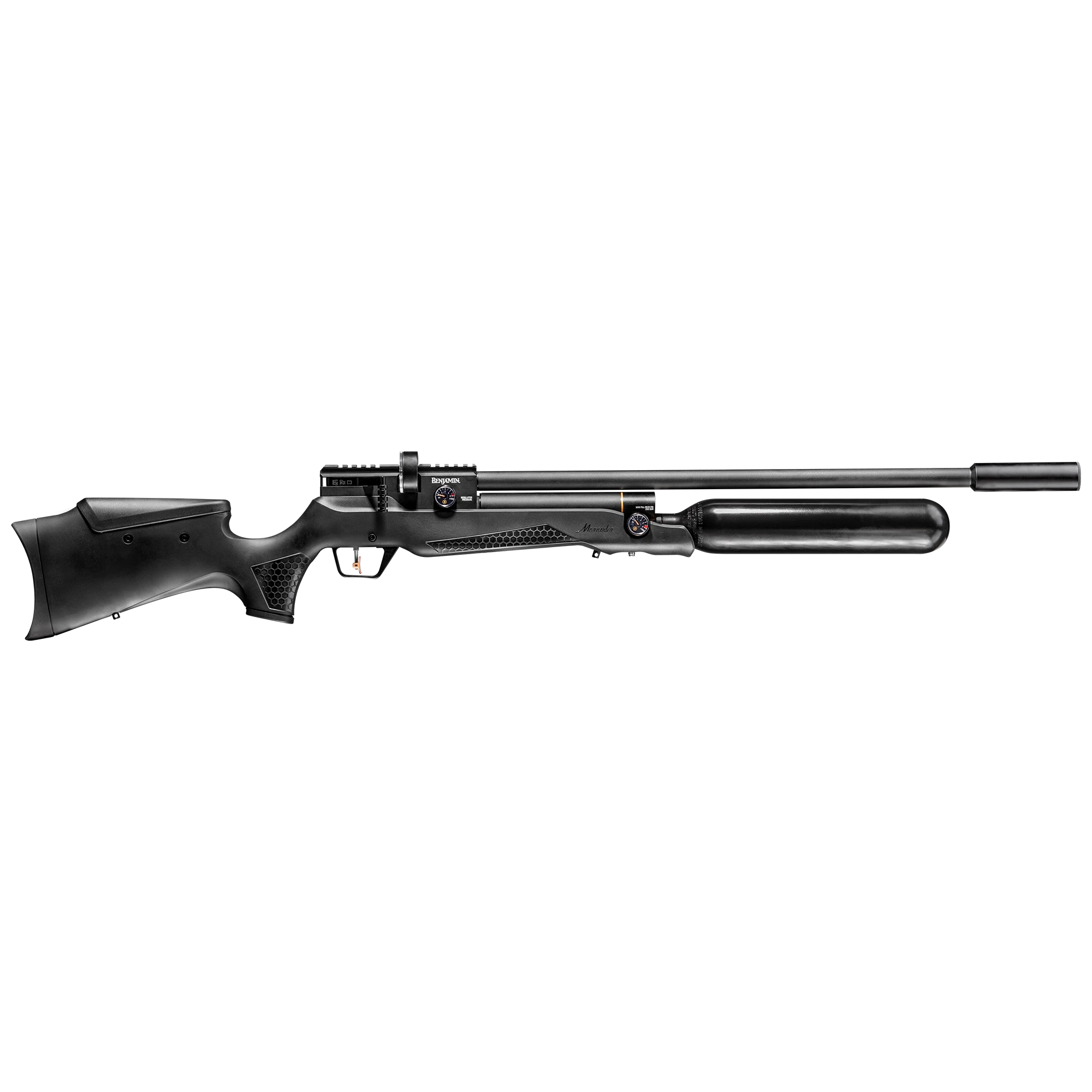
A PCP air rifle, short for pre-charged pneumatic, is powered by compressed air stored in a reservoir inside the gun. You fill that reservoir from an outside source before you shoot, and each trigger pull releases a measured puff of air to push the pellet. PCPs are a common step up from spring and pump guns for shooters who want repeatable power, more shots per fill and less recoil.
The tradeoff is the fill gear. A PCP is not ready to shoot until you have a hand pump, a compressor or a dive-style tank, and every one of those carries a price and a safety rulebook. This guide explains how a PCP works and what the extra equipment costs to own. Airgun laws vary by state and city, and some places treat airguns as firearms, so check your local rules before you buy or shoot.
- A PCP stores compressed air in a reservoir and releases part of it each shot [1].
- Regulated PCPs hold power steady through the charge but cost more [1].
- Shot counts vary from a handful to dozens per fill; only the maker’s listing or manual gives the number for your model.
- Fill gear is the main extra cost, and each gun has its own maximum fill pressure.
How a PCP works
Precharged pneumatic rifles are powered by compressed air contained in an integral air cylinder or a buddy bottle [1]. Unlike a pump gun, which dumps all its stored air each shot, a PCP’s firing valve releases only part of the reservoir per shot, so one fill can give multiple shots [2].
Because there are no heavy parts moving as the gun fires, PCPs produce lower recoil than spring guns [3]. One retailer article says the release of a much larger volume of compressed air from a PCP makes a louder discharge than guns that use a small volume of air, closer to a firearm though not as loud [4]. Some PCPs have an integrated shroud built into the gun.
Regulated and unregulated PCPs
An unregulated PCP’s power output generally rises to a peak and then drops off until it needs recharging [1]. A regulated PCP uses a secondary air chamber, called a plenum, that runs at constant pressure, so air release is controlled for the entire charge and there is no power curve [1].
The price of that consistency is cost. Regulated PCPs cost more than unregulated ones, so their value has to be weighed for your use [1]. For plinking at short range, an unregulated rifle may serve fine; shooters chasing consistency at longer range are the ones most likely to weigh the extra cost. This article does not cover regulator adjustment; leave that to the manufacturer’s service guidance.
How many shots per fill?
The number of shots per fill varies enormously by model, and only the maker’s listing or manual can tell you. The Crosman 3622 PCP lists up to 25 shots on a fill and a 2000 psi reservoir that the listing calls hand pump friendly, at $159.90 in October 2026. The Benjamin Marauder Regulated lists up to 80 shots per fill, at $695.90 in October 2026.
A big-bore Bulldog M357 lists up to 5 shots per fill, at $999.90 in October 2026.
Those are maker claims, and your own count can differ with pellet weight, how the rifle is set up and how it is filled. Treat them as a sense of scale, not a promise.
What a PCP costs to run
Air is free; the gear that compresses it is not. Here are the three common ways to fill, with prices listed in October 2026.
Hand pump effort
Pumping is slow work. Benjamin’s pump manual says approximately 110 strokes were required to reach 2000 psi in its example [5]. A Hatsan manual advises cooling the pump after each 50 strokes or when the rod is very hot, or the seals and o-rings may wear faster [6].
Maintenance
A compressor adds upkeep. Air Venturi’s Nomad manual calls for 2-3 drops of silicone oil every 5 fills or 1.5 hours of use, whichever comes first [7]. A tank needs periodic retesting: Air Venturi’s carbon fiber tank manual says composite cylinders must be hydrostatically tested every 5 years and have a maximum life of 15 years from the original test date [8].
- Hand pump: Benjamin lists its three-stage high pressure hand pump at $209.90, delivering up to 3600 psi. An Amazon listing for a VEVOR three-stage pump shows $49.90; check any pump’s rating against your rifle’s own maximum fill pressure. Benjamin’s pump manual gives a pump rating of 3600 psi and warns against exceeding it [5].
- Compressor: a portable 4500 psi compressor with auto-stop is listed at $179.90, while Benjamin’s home-use Recharge compressor lists at $1685.90.
- Dive-style or carbon fiber tank: one DOT carbon fiber tank listing is $271.99. A tank holds the air but still needs a source to fill it.
Safety with high-pressure air
Every PCP has its own maximum fill pressure and you must not exceed it. The Benjamin Marauder rifle manual says not to fill that airgun to more than 3000 psi [9], the Umarex Gauntlet manual gives a maximum of 3000 psi [10], and the Benjamin Bulldog manual refers to 3000 psi as the point past which you must depressurize [11] [8].
Those figures belong to those manuals; other models, generations and variants differ, so read the manual for your exact gun. A 4500 psi tank rating does not mean your rifle can take 4500 psi; Air Venturi’s tank manual sets 4500 psi as the limit for the tank itself [8] [9] [10] [11].
Use only clean, dry air. The tank manual says fill air must not contain oil, water or other contaminants, and that the filling compressor needs working filters and moisture separators [8]. It also says to use no oxygen, which can cause a fire or explosion [8]. Bleed the fill hose before disconnecting; the Marauder manual warns about hose whip [9]. The Marauder manual says not to use a standard air compressor or bicycle pump [12]; use fill equipment made for pre-charged airguns.
Three example buyers
For example, a gardener who shoots a few times a week at a short backyard range does not need a rifle with a huge shot count, so a hand-pumpable model with a modest reservoir keeps costs low. A target shooter who wants identical shots from the first pellet to the last should look at regulated rifles, since a regulator is designed to hold power steady through the charge [1].
A hunter who travels may want a dive-style tank or a portable compressor so refills do not depend on a hand pump.
Those are examples, not rules. Whatever you pick, price the whole system: rifle, fill gear, a way to keep the air dry, and the periodic retesting a tank needs. The rifle is often the smaller part of the bill.
Who should buy one
A PCP suits shooters who will fire regularly enough to justify the fill gear, who want less recoil, and who care about accuracy and consistency. A shooter who plinks twice a year may be happier with a spring or pump gun. If you plan pest control or small game with a PCP, check your state wildlife agency’s rules first, because limits vary by state.
Store the rifle unloaded and away from children, as the Marauder manual says [12]. Wear eye protection, use a safe backstop and do not point any airgun at a person.
FAQ
What does PCP stand for?
Precharged pneumatic. The rifle is powered by compressed air stored in an integral cylinder or a buddy bottle [1].
Do I need a compressor to shoot a PCP?
No. You can fill with a hand pump, a dive-style tank or a compressor. A hand pump suits a low-volume shooter, though it takes effort: Benjamin’s pump manual says approximately 110 strokes were required to reach 2000 psi in its example [5].
Can I fill my PCP from a car tire compressor?
No. The Marauder manual says to use only a pump designed for filling a pre-charged airgun and not a standard air compressor or bicycle pump [9].
Is a PCP louder than a spring rifle?
Often, yes. A retailer article says a PCP’s much larger release of compressed air generates a louder discharge than the low-air-volume powerplants it compares against [4]. Check the listing for any shroud the model has.
High-pressure air can injure or kill. Never exceed your rifle’s or tank’s rated pressure, inspect and retest cylinders on schedule, and read the manual for your exact model. Do not modify a regulator or any safety feature.
Sources
- Regulated PCP vs Unregulated (Nigel Allen). Daystate Ltd (airgun manufacturer), accessed 2026-10-13
- How Does A Pneumatic Air Rifle Work?. Airgun Depot (airgun retailer), accessed 2026-10-13
- Air gun. Wikipedia, accessed 2026-10-13
- Shrouded Barrels (Afield on Airguns). Airguns of Arizona (airgun retailer blog; not a primary legal source), accessed 2026-10-13
- Benjamin Three Stage High Pressure Hand Pump Model HPP2K Owner's Manual (HPP2KA515). Crosman Corporation / Benjamin (owner’s manual PDF hosted by Pyramyd Air), accessed 2026-10-13
- Hatsan hand pump instruction manual (warnings and maintenance). Hatsan Airguns (manufacturer manual), accessed 2026-10-13
- User Instruction Manual NOMAD 4500 PSI Portable Air Compressor AV-MCOMP4500. Air Venturi (manufacturer manual, hosted by Pyramyd AIR), accessed 2026-10-13
- Carbon fiber tank owner's manual (Air Venturi, 90 cu in tank and regulator). Air Venturi (manufacturer manual, hosted by Pyramyd AIR), accessed 2026-10-13
- Benjamin Marauder PCP Air Rifle Owner's Manual (BP1764 / BP2264 / BP2564). Crosman Corporation / Benjamin (owner’s manual PDF hosted by Pyramyd Air), accessed 2026-10-13
- Umarex Gauntlet PCP Air Rifle Owner's Manual (2252603 / 2252604). Umarex USA (owner’s manual PDF on umarexusa.com), accessed 2026-10-13
- Benjamin Bulldog .357 Bullpup Pre-Charged Pneumatic Air Rifle Owner's Manual. Crosman Corporation / Benjamin (owner’s manual PDF hosted by Pyramyd Air), accessed 2026-10-13
- Benjamin Marauder pre-charged pneumatic airgun owner's manual (BP1764/BP2264/BP2564). Crosman Corporation (Benjamin; manufacturer manual, hosted by Pyramyd AIR), accessed 2026-10-13
Velocity, energy and shot-count figures are quoted as the manufacturer states them unless a test source is named. Airgun laws vary by state, county and city, and some places treat airguns as firearms; check your local law before buying or shooting. Adults should supervise young shooters, and everyone in range should wear eye protection. Hunting and pest control are governed by state wildlife rules. We do not sell or link to firearms or firearm ammunition. This is general information, not legal advice. As an Amazon Associate we earn from qualifying purchases.