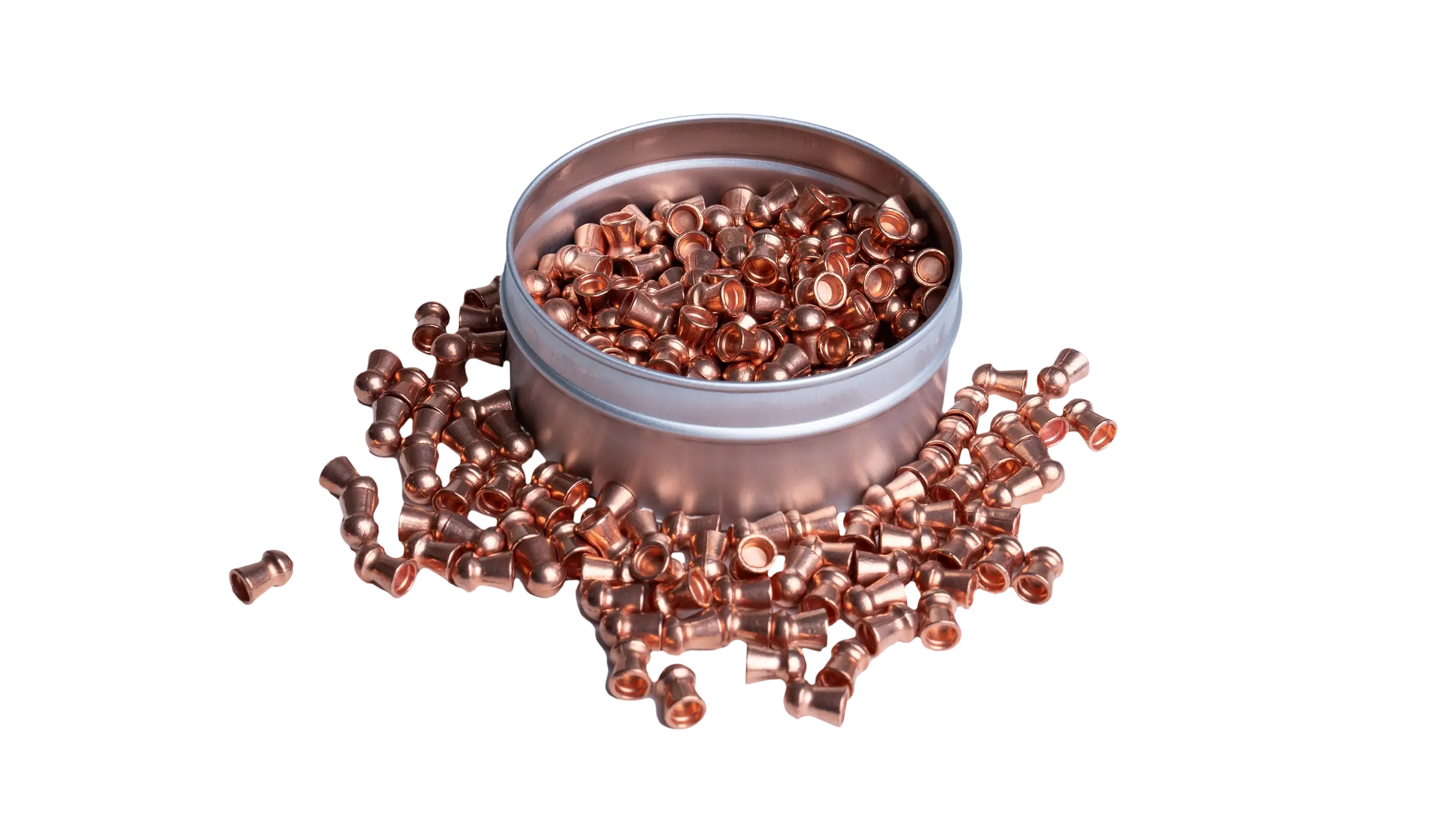
Airgun pellets are shaped projectiles, usually lead, fired from rifled airguns, and the shape, weight and caliber you load change how the gun shoots. A wadcutter is made for paper, a domed pellet keeps its energy longer (Crosman calls it ideal for hunting) and a hollow point is built to expand. Buy by the job you have and by what your owner’s manual allows, not by the packaging.
This guide explains pellet shapes, calibers and weights, with listed examples and prices from October 2026, and covers the lead handling rules that apply to every tin. Airgun laws vary by state and city, and some places treat airguns as firearms, so check local rules. Pellets are not toys: wear eye protection, shoot only at a safe backstop, and keep tins away from young children.
- Choose the shape by job: wadcutter for paper, domed for energy retention and hunting, pointed for velocity retention, hollow point for expansion [1].
- Load only the caliber your manual names, and never reuse pellets in a gun whose maker says not to [2].
- Box velocity assumes a light pellet; heavier pellets may be 100-150 ft/sec slower but hit harder [3].
- Wash your hands after handling lead pellets and keep food away from the range [4].
Four shapes, four jobs
Crosman says small-bore airgun pellets come in roughly four shapes, and that your intended use will dictate which one suits your airgun best [5]. Wikipedia lists the head forms as flat (wadcutter), hemispherical (round nose), hollow point and conical (pointed) [6].
Crosman describes each shape by job. A wadcutter has a flat head designed to cut round holes in a paper target and is a good choice for competition, target shooting and plinking [1]. A round nose or domed pellet generally retains its energy longer, which Crosman says makes it ideal for hunting [1]. A pointed pellet has good velocity retention and suits hunting and plinking, and a hollow point has a cavity that promotes expansion on impact [1]. Wikipedia notes that match pellets in .177 are wadcutters that leave clean round holes in paper for easy scoring [6].
Calibers: match the pellet to the barrel
Crosman lists the small-bore calibers as .177, .20, .22 and .25 [5]. The gun fixes the choice. Crosman’s 2240 manual says to use only .22 caliber pellets and never to reuse ammunition [2]. Gamo’s break-barrel handbook says its rifle shoots .177 lead or alloy pellets and is not intended to shoot steel BBs [7].
BBs are a separate case. Pyramyd AIR says BBs belong in a pellet gun only if the manual says it can use both, since most pellet guns have rifled barrels that steel BBs can damage [8]. Check the manual before you load anything unusual.
Caliber also changes how energy and range trade off. On one retailer’s rifle, .177 with a 7.0 grain RWS hobby pellet averaged 986.6 fps and 15.13 FPE, while .22 with an 11.9 grain pellet averaged 780.8 fps and 16.37 FPE [9]. The same article calculated a flat-shooting zone of 32.3 yards for the .177 and 26.3 yards for the .22 on that rifle [9]. On that rifle the .22 hit slightly harder and the .177 shot flatter.
Weight, velocity and energy
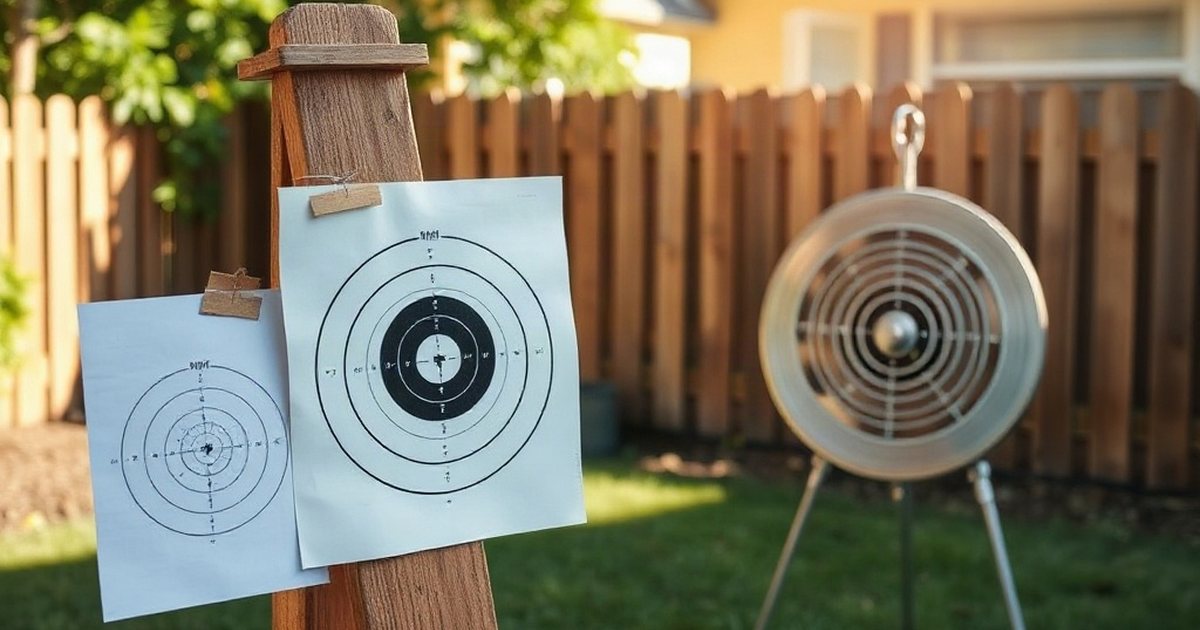
Heavier pellets are slower, and box velocities assume light ones [3].
Crosman says advertised velocity is usually obtained with a very light pellet and may be a generous estimate, and a rifle advertised at 1000 ft/sec might give only 875-900 ft/sec with pellets of normal weight [3]. In .177, Crosman puts a light pellet at 6.7 grains, a normal one at about 7.9 grains and a heavy one at up to 10 grains, with velocity as much as 100-150 ft/sec lower on the heavy ones [3] [9].
What you gain is energy and, in most cases, better velocity retention. Crosman says heavier pellets pack an extra punch and in most cases retain velocity more effectively [3]. Muzzle energy in foot-pounds is weight in grains times velocity squared in fps, divided by 450,240 [10]. For example, an 8-grain pellet at 800 fps makes 11.37 foot-pounds by that formula [10].
Listed pellets by job
Prices below are exact listed figures from October 2026. Each pick gives something up.
Crosman Wadcutter (.177)
Crosman lists this flat-nose pellet at 7.4 grains in a 250-count tin at $8.90. It is made for paper, so it gives up hunting performance. The Stoeger X-Sport is a lower-priced alternative at $6.49 for 500, and the Challenger Competition Select at 8.06 grains for competition was listed at $24.90 but unavailable.
Crosman Premier LDP22
Crosman lists the Premier LDP22 at 14.3 grain in a 500-count tin at $15.99 for Crosman PCP and break-barrel airguns. It gives up the copper coating of the tin below.

Crosman Premier Copper Domed .22
The Premier copper domed .22 is listed at 14.4 grain in a 150-count tin for $16.90, with a copper coating Crosman says is designed to help reduce barrel fouling. It gives up count per dollar.
Hollow points and mixed packs
Benjamin lists a .22 hollow point hunting pellet at 14.3 grain, 500 count, at $15.90, and recommends saving it for hunting. H&N lists the Terminator .177 hollowpoint at 7.25 grains, 400 count, at $7.90. Gamo sells a .177 combo pack of four pellet types at $17.99, all at the same 7.6 grain weight according to Gamo, so nose shape is the main difference. Hunting rules come from your state wildlife agency, so check them before you use hollow points on game.
Slugs, long pellets and minimum energy labels
Not every pellet suits every gun. Wikipedia says slug-style pellets have more contact surface with the bore and need greater propelling force, but have better ballistic coefficients and longer effective ranges [6]. They are aimed at powerful PCPs.
Read listing details.
The Harpex arrowhead .22 pellet is listed at 20.1 grain and 12.2 mm long, and the listing says it exceeds most magazine capacities and suits single-load rifles only. The H&N Hornet .177 pointed pellet is listed for airguns with a minimum muzzle energy of 5.5 ft.lbs. A low-power spring rifle may not drive such a pellet well [6].
A short buying checklist
Work through the decision in this order and the shelf gets smaller fast:
- Caliber first, straight from your owner’s manual, because the wrong size can jam or damage the gun.
- Shape second, from the job: paper, plinking, general use or pest control.
- Weight third, remembering that heavier pellets are slower but carry more energy, and that your rifle may prefer a particular weight.
- Count and price last. Divide the price by the number of pellets before you compare tins.
- For example, a 250-count tin at $8.90 is about 3.6 cents a pellet, while a 500-count tin at $6.49 is about 1.3 cents a pellet. Cost per pellet matters most for plinking, where you shoot hundreds.
Handling lead pellets safely
Lead is toxic if swallowed. The Civilian Marksmanship Program’s air gun guide gives two basic rules: wash your hands with soap and water after shooting, and keep food and open drinks off the range [4]. It adds that pellets should never go in the mouth, and that only authorized adults should remove lead from pellet traps [4].
Use the right trap. Champion describes its steel trap as for lead projectiles only, compatible with airgun pellets [11]. Never shoot steel BBs into a trap built for pellets, as Daisy warns that improper targets may cause ricochet [12].
FAQ
What pellet shape is best for target shooting?
A wadcutter, which Crosman says has a flat head designed to cut round holes in paper and suits competition, target shooting and plinking [1].
Can I shoot BBs in a pellet gun?
Only if the manual says so. Pyramyd AIR says most pellet guns have rifled barrels that steel BBs can damage [8].
Does a heavier pellet always shoot better?
Not always. Crosman says heavier pellets may be 100-150 ft/sec slower than light ones, though they usually pack more punch and hold velocity better [3].
Are lead pellets dangerous to handle?
Lead is toxic if ingested. The CMP guide says to wash hands with soap and water after shooting and to keep food off air gun ranges [4].
Pellets are projectiles: shoot only at a safe backstop, wear eye protection, and store pellets away from young children. Lead is toxic if swallowed. Airgun laws vary by state and city, so check local rules.
Sources
- Airgun Ammunition. Crosman (airgun manufacturer), accessed 2026-10-13
- Crosman Model 2240 .22 Caliber Single Shot Pellet CO2 Airgun Owner's Manual (2240A515). Crosman Corporation (owner’s manual PDF, copy hosted by arprotech.com), accessed 2026-10-13
- Air Gun Ballistics. Crosman (airgun manufacturer), accessed 2026-10-13
- Guide to Lead Management for Air Gun Shooting. USA Shooting and the Civilian Marksmanship Program (shooting-sports bodies, an interested party), accessed 2026-10-13
- Take Your Best Shot with Crosman: Airgun Pellets 101. Crosman (airgun manufacturer), accessed 2026-10-13
- Pellet (air gun). Wikipedia, accessed 2026-10-13
- Gamo Break Barrel Air Rifle Handbook (Industrias El Gamo). Industrias El Gamo, S.A. (handbook PDF hosted by MidwayUSA), accessed 2026-10-13
- BBs: Copper, Steel or Lead BBs. Pyramyd AIR (airgun retailer), accessed 2026-10-13
- From the Mailbag: .177 vs .22 for hunting. Airgun Depot (airgun retailer), accessed 2026-10-13
- Muzzle Energy Explanation & Definition. Pyramyd AIR (airgun retailer), accessed 2026-10-13
- Champion Heavy Duty Metal Trap. Airgun Depot (retailer) quoting Champion product description, accessed 2026-10-13
- Daisy Model 74 CO2 BB Gun Owner's Manual. Daisy Outdoor Products (manufacturer), hosted by Pyramyd AIR, accessed 2026-10-13
Velocity, energy and shot-count figures are quoted as the manufacturer states them unless a test source is named. Airgun laws vary by state, county and city, and some places treat airguns as firearms; check your local law before buying or shooting. Adults should supervise young shooters, and everyone in range should wear eye protection. Hunting and pest control are governed by state wildlife rules. We do not sell or link to firearms or firearm ammunition. This is general information, not legal advice. As an Amazon Associate we earn from qualifying purchases.